mere company ki ladkiyaan sunder hain aur lonely hain...
Problem ye hai ki bus voh READ-ONLY hain...
Shayad mere pyar ko taste karna bhool gaye...
Dil sey aisa CUT kiya ke PASTE karna bhool gaye..
Tumhare samne hain itney items kabhi hame bhi pick karo...
Hamare pyar ke ICON pe kabhi to tum DOUBLE-CLICK karo...
Roz subha hum karte hai itne pyar se unhe good morning...
Woh humhe ghoor kar dekhte hain jaise 0 ERRORS but 5 WARNINGS...
Ho gayi galti humse,
Click ho gaya mouse
Duniya ki parwaah chhodo,
Ban jaao meri spouse!
Tumse mila main kal to,
Mere dil mein hua ek sound,
Lekin aaj tum mili
To kehti ho: Your file not found!
Ab aur kaho na tum, "but" ya "if"
Tum ho meri zindagi ki animated gif
Aysa bhi nahin hai ke,
I don't like your face
Par dil ke computer mein,
Nahin hai enough disk space
Ghar se nikalti ho tum jab,
Pehen ke evening gown
Too many requests se,
Ho jaata hai server down
Tumhaare liye pyaar ki application,
Create main karoonga
Tum usse debug karna,
Wait main karoonga
Tumhaara intezaar karte karte,
Main so gaya
Yeh dekho mera connection,
Time out ho gaya
Kya chaal hai tumhaari,
Jaise chalti hai koi cat
What is your ICQ number,
Aao karein chat
Tum jabse meri zindagi mein aayi ho banke female,
Yaad raha na ab kuch na postman na e-mail
Joh sadiyaon se hota aaya hai W
oh repeat kar doonga...
Tu naa mili to tujhko dil sey
Ctrl+Alt+Delete kar doonga...
Humse Kya Khata Hui Ki message Aanna Band Hai.......
Aap hi humse naraz hain ya Web Server band hai.......
Badli hai duniya , kuchch mein bhi badal gaya hoon
Pahle bekaar tha ab S/W Programmer ban gaya hoon
VC aaye to VB mein daal do,
VC aaye to VB mein daal do
seedhe seedhe sabko museebat mein daal do
Project extend ho gaya to kya ho jaata hai?
Are Tankha milti hai aur timepass ho jata hai..
teri yaad me sanam raat bhar humne to wine piya
teri yaad me sanam raat bhar humne to wine piya
kabhi offline to kabhi online piya
Pyar ke sitaare jab gardish mein hote hai
Pyar ke sitaare jab gardish mein hote hai
Laila ghar mein aur majnoo project testing kar rahe hote hai
Tuesday, January 31, 2006

Monday, January 30, 2006
Politically correct statements in a Ph. D thesis
"It has long been known..."
I didn't look up the original reference.
"A definite trend is evident..."
The data is practically useless.
"While it has not been possible to provide definite answers to the questions..."
An unsuccessful experiment, but I still hope to get it published.
"Three of the samples were chosen for detailed study..."
The other results didn't make any sense.
"Typical results are shown..."
This is the prettiest graph.
"These results will be in a subsequent report..."
I might get around to this sometime, if pushed/funded.
"The most reliable results are obtained by xxxxx..."
Xxxxx was my graduate student; his grade depended on this.
"In my experience..."
Once.
"In case after case..."
Twice.
"In a series of cases..."
Thrice.
"It is believed that..."
I think.
"It is generally believed that..."
A couple of other guys think so too.
"Correct within an order of magnitude..."
Wrong.
"According to the statistical analysis..."
Rumor has it.
"A statistically oriented projection of the significance of these findings..."
A wild guess.
"A careful analysis of obtainable data..."
Three pages of notes were obliterated when I knocked over a glass of beer.
"It is clear that much additional work will be required before a complete understanding of this phenomena occurs..."
I don't understand it.
"After additional study by my colleagues..."
They don't understand it either.
"Thanks are due to Mr. Smith for assisstance with the experiment and Miss Jones for valuable discussions..."
Harry Smith did the experiment and Mary Jones explained to me what it meant.
"A highly significant area for exploratory study..."
A totally useless topic selected by my committee.
"It is hoped that this study will stimulate further investigation in this field..."
I quit.
I didn't look up the original reference.
"A definite trend is evident..."
The data is practically useless.
"While it has not been possible to provide definite answers to the questions..."
An unsuccessful experiment, but I still hope to get it published.
"Three of the samples were chosen for detailed study..."
The other results didn't make any sense.
"Typical results are shown..."
This is the prettiest graph.
"These results will be in a subsequent report..."
I might get around to this sometime, if pushed/funded.
"The most reliable results are obtained by xxxxx..."
Xxxxx was my graduate student; his grade depended on this.
"In my experience..."
Once.
"In case after case..."
Twice.
"In a series of cases..."
Thrice.
"It is believed that..."
I think.
"It is generally believed that..."
A couple of other guys think so too.
"Correct within an order of magnitude..."
Wrong.
"According to the statistical analysis..."
Rumor has it.
"A statistically oriented projection of the significance of these findings..."
A wild guess.
"A careful analysis of obtainable data..."
Three pages of notes were obliterated when I knocked over a glass of beer.
"It is clear that much additional work will be required before a complete understanding of this phenomena occurs..."
I don't understand it.
"After additional study by my colleagues..."
They don't understand it either.
"Thanks are due to Mr. Smith for assisstance with the experiment and Miss Jones for valuable discussions..."
Harry Smith did the experiment and Mary Jones explained to me what it meant.
"A highly significant area for exploratory study..."
A totally useless topic selected by my committee.
"It is hoped that this study will stimulate further investigation in this field..."
I quit.
Saturday, January 28, 2006
Processor Pipeline
This is probably one of the most confusing parts of the processor to understand. The processor pipeline is like a conveyor belt. Now, imagine that instructions for the processor to carry out is food. The way a pipeline works is like this: the food moves along the conveyor belt, and when it gets to the other end of the conveyor belt that instruction is done. That is the simple way, but that is not technically correct. The way it works is this, (can’t think of any other way to explain it here) an instruction is fetched from the cache, then it continues to a different part of the pipeline, and so on. There are lots of different pipeline sizes, it all depends on what processor you have. This will explain how AMD manages to perform against Intel, even though Intel has a much higher clock speed than AMD.
The different parts of the pipeline perform different jobs. Some parts of the pipeline are duplicated, and adds to the length of the pipeline. Also, there can be more than one pipeline, which is why modern processors are said to have a super scalar architecture. The reason parts of the pipeline are duplicated is so less work has to be done at each stage. This means more instructions are completed in the same amount of time, speeding up performance. This is one of the key reasons AMD is able to contend with Intel. AMD Athlon XP’s have 3 X86 decoders, 3 floating-point pipelines, and 3 integer pipelines. This is compared with Intel’s Pentium 4, which has only one X86 decoder, 2 floating-point pipelines, and 1 more integer pipeline than AMD’s Athlon. This leads to AMD being able to decode more instructions than Intel at the same time, and being able to perform floating-point operations quicker than Intel. Overall, AMD Athlon XP processors are able to perform 9 operations per clock cycle while Intel can only manage 6. It doesn’t sound like much, but in processors every operation is crucial. This is why I said AMD are more about getting more done per clock cycle in my AMD processor buying guide.
This doesn’t mean it’s all over for Intel though. Even though AMD manages to perform more operations than Intel in one clock cycle, Intel manages to do their operations quicker. This is because of their pipeline architecture. AMD’s pipeline is only 10 stages long. This means that because the stages in the pipeline have to do more work, they can’t run very fast. Now, with Intel, their processors have a 20 stage pipeline (Prescott core processors have 31 stages). This means that the processor can run at a higher clock speed, because less work is done in each stage of the pipeline. The reason the Prescott core has been released is because this brings yet more speed. Because there are 31 stages, even less work is done, which means even higher clock speeds.
This can be linked to CISC computing and RISC computing. CISC stands for complex instruction set computing, and RISC stands for reduced instruction set computing. RISC means having less complex instructions for the processor. Here is an example of CISC giving someone commands. With CISC it would look like this:
1. Get food
2. Get fork
3. Eat
But with RISC it would be like this:
1. Go to kitchen
2. open fridge
3. get food
4. close fridge
5. open drawer
6. get fork
7. close drawer
8. open mouth
9. put food in mouth
10. close mouth
11. chew
12. swallow
The reason the CISC is more complex is because the processor has a lot more to do in one instruction. RISC is more efficient because it is very simple instructions, meaning less "thinking" is needed to perform the instruction, resulting in faster speed. Also, using RISC means there is less transistors needed in a processor, reducing cost. This is why all modern processors are RISC processors. But there is something you should know about X86 (the way the instructions are coded). X86 is actually built using a CISC architecture. This is why the processors need X86 decoders, to convert the CISC instructions into RISC instructions.
Now, even though Intel has the advantage of faster clock speeds, this doesn’t work well unless you have a lot of something. Cache. Cache is where all the instructions the processor is going to work on resides. All the cache’s data comes from main memory (RAM). When a processor is going to work on an instruction, it checks the cache to see if it is there. Cache runs at the core speed of the processor, so if you have an Intel 2.6GHz processor, the cache will also be running at 2.6GHz. Now compare this to main memory. Main memory, at the most without over clocking, runs at 400MHz. If a processor can’t find an instruction in the cache, then it has to slow right down to match the speed of the main memory, until it can get the next instruction from it. This makes a massive drop in performance, and is the reason the Celeron processors are such poor performers. With less cache, there are fewer instructions ready for the processor, increasing the chance that the processor will have to slow down to main memory speed. The reason the Intel processors are more susceptible to slowing down is because of a technique processors use to decide which instruction to work on next.
This is what is called pipeline optimization: The processor will always try to keep the pipeline full. To do this, it has to use techniques to guess what will come next. There are 3 different ways of optimizing the pipeline. These ways are:
Speculative execution - This is where the CPU has an instruction, and the next instruction cannot take place unless the CPU knows the answer to the first instruction. The CPU has to work out the answer to the first instruction, but say there is 2 instruction answers, and only one is correct. Without speculative execution, the CPU would send one of the possible answers to the instruction down the pipeline, which in an Intel CPU would take 20 clock cycles to complete. Now, if the CPU chooses the correct instruction answer, then everything is fine, the CPU can go right onto the next one. But what if it is the wrong one? The CPU has to send the other instruction answer down the pipeline, which would mean 20 clock cycles were wasted with the first instruction! So what speculative execution does is send both possible instruction answers down the pipeline, so the CPU processes both. The CPU processes both, then discards the incorrect one. That means a lot less time was wasted.
Branch prediction - This is a tough one, and can mean running at full speed without having to slow down, or having to completely start again from the start of the instruction set for a processor. This builds onto speculative execution. Remember when I said the processor will always want a full pipeline? Well, just because there is 2 possible answers doesn’t mean there is any exception. What will happen is this: The processor will see the 2 possible answers, and will make an educated guess which one is correct from the branch target buffer before the CPU executes both instructions. So, both instructions are not executed anymore, only one of them is, which is the one the CPU predicts will be correct. The branch target buffer is a bank of all the answers that turned out to be right from other instructions, and from looking at this bank the CPU can take a guess which is the correct answer from what it has already done. When the CPU looks in this bank, it allows a good prediction because it has all the results from other instructions. So after sending the instruction that the CPU has guessed correct, the instructions that would come after this prediction are also sent down the pipeline. If the CPU was right with the branch prediction, then there will be a lot of time saved. If not, the whole pipeline has to be flushed and restarted, because it all counted on the first instruction being guessed correctly. This is why the Pentium 4 needs more intelligent branch prediction technology, with a long pipeline it takes a long time for a new set of instructions to reach the end of the pipeline.
Out of order execution - This is where the second instruction cannot be performed, because the CPU has to know the answer to the first instruction before the CPU can know what the answer is to the second one. Without out of order execution, the CPU would execute the first instruction, and leave the rest of the pipeline empty. This would be a massive waste of resources. So what happens is this, the CPU will execute the first instruction, then execute other instructions that have no dependency on the first instruction. So with this, the CPU can work on other instructions while it is waiting for the first one.
The different parts of the pipeline perform different jobs. Some parts of the pipeline are duplicated, and adds to the length of the pipeline. Also, there can be more than one pipeline, which is why modern processors are said to have a super scalar architecture. The reason parts of the pipeline are duplicated is so less work has to be done at each stage. This means more instructions are completed in the same amount of time, speeding up performance. This is one of the key reasons AMD is able to contend with Intel. AMD Athlon XP’s have 3 X86 decoders, 3 floating-point pipelines, and 3 integer pipelines. This is compared with Intel’s Pentium 4, which has only one X86 decoder, 2 floating-point pipelines, and 1 more integer pipeline than AMD’s Athlon. This leads to AMD being able to decode more instructions than Intel at the same time, and being able to perform floating-point operations quicker than Intel. Overall, AMD Athlon XP processors are able to perform 9 operations per clock cycle while Intel can only manage 6. It doesn’t sound like much, but in processors every operation is crucial. This is why I said AMD are more about getting more done per clock cycle in my AMD processor buying guide.
This doesn’t mean it’s all over for Intel though. Even though AMD manages to perform more operations than Intel in one clock cycle, Intel manages to do their operations quicker. This is because of their pipeline architecture. AMD’s pipeline is only 10 stages long. This means that because the stages in the pipeline have to do more work, they can’t run very fast. Now, with Intel, their processors have a 20 stage pipeline (Prescott core processors have 31 stages). This means that the processor can run at a higher clock speed, because less work is done in each stage of the pipeline. The reason the Prescott core has been released is because this brings yet more speed. Because there are 31 stages, even less work is done, which means even higher clock speeds.
This can be linked to CISC computing and RISC computing. CISC stands for complex instruction set computing, and RISC stands for reduced instruction set computing. RISC means having less complex instructions for the processor. Here is an example of CISC giving someone commands. With CISC it would look like this:
1. Get food
2. Get fork
3. Eat
But with RISC it would be like this:
1. Go to kitchen
2. open fridge
3. get food
4. close fridge
5. open drawer
6. get fork
7. close drawer
8. open mouth
9. put food in mouth
10. close mouth
11. chew
12. swallow
The reason the CISC is more complex is because the processor has a lot more to do in one instruction. RISC is more efficient because it is very simple instructions, meaning less "thinking" is needed to perform the instruction, resulting in faster speed. Also, using RISC means there is less transistors needed in a processor, reducing cost. This is why all modern processors are RISC processors. But there is something you should know about X86 (the way the instructions are coded). X86 is actually built using a CISC architecture. This is why the processors need X86 decoders, to convert the CISC instructions into RISC instructions.
Now, even though Intel has the advantage of faster clock speeds, this doesn’t work well unless you have a lot of something. Cache. Cache is where all the instructions the processor is going to work on resides. All the cache’s data comes from main memory (RAM). When a processor is going to work on an instruction, it checks the cache to see if it is there. Cache runs at the core speed of the processor, so if you have an Intel 2.6GHz processor, the cache will also be running at 2.6GHz. Now compare this to main memory. Main memory, at the most without over clocking, runs at 400MHz. If a processor can’t find an instruction in the cache, then it has to slow right down to match the speed of the main memory, until it can get the next instruction from it. This makes a massive drop in performance, and is the reason the Celeron processors are such poor performers. With less cache, there are fewer instructions ready for the processor, increasing the chance that the processor will have to slow down to main memory speed. The reason the Intel processors are more susceptible to slowing down is because of a technique processors use to decide which instruction to work on next.
This is what is called pipeline optimization: The processor will always try to keep the pipeline full. To do this, it has to use techniques to guess what will come next. There are 3 different ways of optimizing the pipeline. These ways are:
Speculative execution - This is where the CPU has an instruction, and the next instruction cannot take place unless the CPU knows the answer to the first instruction. The CPU has to work out the answer to the first instruction, but say there is 2 instruction answers, and only one is correct. Without speculative execution, the CPU would send one of the possible answers to the instruction down the pipeline, which in an Intel CPU would take 20 clock cycles to complete. Now, if the CPU chooses the correct instruction answer, then everything is fine, the CPU can go right onto the next one. But what if it is the wrong one? The CPU has to send the other instruction answer down the pipeline, which would mean 20 clock cycles were wasted with the first instruction! So what speculative execution does is send both possible instruction answers down the pipeline, so the CPU processes both. The CPU processes both, then discards the incorrect one. That means a lot less time was wasted.
Branch prediction - This is a tough one, and can mean running at full speed without having to slow down, or having to completely start again from the start of the instruction set for a processor. This builds onto speculative execution. Remember when I said the processor will always want a full pipeline? Well, just because there is 2 possible answers doesn’t mean there is any exception. What will happen is this: The processor will see the 2 possible answers, and will make an educated guess which one is correct from the branch target buffer before the CPU executes both instructions. So, both instructions are not executed anymore, only one of them is, which is the one the CPU predicts will be correct. The branch target buffer is a bank of all the answers that turned out to be right from other instructions, and from looking at this bank the CPU can take a guess which is the correct answer from what it has already done. When the CPU looks in this bank, it allows a good prediction because it has all the results from other instructions. So after sending the instruction that the CPU has guessed correct, the instructions that would come after this prediction are also sent down the pipeline. If the CPU was right with the branch prediction, then there will be a lot of time saved. If not, the whole pipeline has to be flushed and restarted, because it all counted on the first instruction being guessed correctly. This is why the Pentium 4 needs more intelligent branch prediction technology, with a long pipeline it takes a long time for a new set of instructions to reach the end of the pipeline.
Out of order execution - This is where the second instruction cannot be performed, because the CPU has to know the answer to the first instruction before the CPU can know what the answer is to the second one. Without out of order execution, the CPU would execute the first instruction, and leave the rest of the pipeline empty. This would be a massive waste of resources. So what happens is this, the CPU will execute the first instruction, then execute other instructions that have no dependency on the first instruction. So with this, the CPU can work on other instructions while it is waiting for the first one.
Thursday, January 19, 2006
Indian Air Force finally apologizes to Mrs. Kavita Gadgil
The results of an internet search by the grieving mother of a MIG-21 pilot killed in a 2001 crash forced the IAF to finally admit that the young officer was not responsible for his own death.
Four years—and endless letters, emails and phone calls—after Flt Lt Abhijeet Gadgil died in a fiery crash, Kavita Gadgil (54) just got some kind of closure in the form of an apology from Air Chief Marshal S P Tyagi.
Until now, the IAF said it shared Gadgil’s anguish but implied that a lack of flying skills claimed the life of Lt Gadgil in Rajasthan on September 17, 2001.
Worse, on behalf of the IAF, Air Marshal Ashok Goel wrote to Gadgil in March 2003, accusing her of carrying a ‘‘public tirade’’ which would ‘‘demoralise the force and would not be in the best interest of the nation’’.
But on March 23 this year—five days after an Air Marshal was flown to Mumbai from air headquarters in Delhi to apologise—Air Chief Marshal S P Tyagi finally acknowledged in a letter to Gadgil that her son’s crash ‘‘may have been triggered by a trim malfunction’’. Tyagi also said the IAF was expunging Goel’s letter from its records.
In the end, the door Gadgil was looking for came from an internet search on spatial disorientation: it put her in touch with an IAF doctor on the panel of the crash inquiry.
A case study published by aviation medicine specialist, Wing Cdr (Dr) R Ravi in the Indian Journal of Aerospace Medicine quoted details of the crash, without naming the pilot: it was apparent pilot error was not the cause.
Armed with this evidence, Gadgil approached the air chief. Last week, the Air Marshal flew down to meet her.
‘‘But I wanted nothing less than an admission from the Chief,’’ said Gadgil, whose husband, a 20-year veteran of the IAF pilot, is about to retire from Air-India.
That admission came in the letter to the Gadgils: Tyagi expressed his condolences and regret.
‘‘He (Lt Gadgil) was a good member of the IAF, and his loss would be difficult to replace,’’ wrote the chief.
The apology is unprecedented, but for Gadgil it comes late.
‘‘How many Kavita Gadgils will have to stand up to be counted? Is it worth it?’’ asked Gadgil, whose determined, unwavering campaign against the MIG-21—157 pilots have died in more than 360 crashes since the 1970s—has taken her to President A P J Abdul Kalam.
‘‘I have put aside my pain all these years to reach the truth,’’ Gadgil said.
In February 2003, Gadgil first wrote to the Chief of Air Staff, asking why Abhijeet’s plane crashed. She was told the accident resulted from the pilot’s ‘‘spatial disorientation’’.
A spate of letters—the last in August 2004—and e-mails had no result. It was after she approached the National Human Rights Commision (NHRC) in December that the air chief wrote.
Gadgil said she is a staunch supporter of the IAF.
‘‘You can buy F16s, but you can’t buy the pilots,’’ she said. ‘‘We have such fine boys joining the force. So many more Abhijeets are still flying. But we need some transperancy. The Air Force has taught me many things. But we also have a right to ask the IAF: ‘what are you doing with our sons?’’
Four years—and endless letters, emails and phone calls—after Flt Lt Abhijeet Gadgil died in a fiery crash, Kavita Gadgil (54) just got some kind of closure in the form of an apology from Air Chief Marshal S P Tyagi.
Until now, the IAF said it shared Gadgil’s anguish but implied that a lack of flying skills claimed the life of Lt Gadgil in Rajasthan on September 17, 2001.
Worse, on behalf of the IAF, Air Marshal Ashok Goel wrote to Gadgil in March 2003, accusing her of carrying a ‘‘public tirade’’ which would ‘‘demoralise the force and would not be in the best interest of the nation’’.
But on March 23 this year—five days after an Air Marshal was flown to Mumbai from air headquarters in Delhi to apologise—Air Chief Marshal S P Tyagi finally acknowledged in a letter to Gadgil that her son’s crash ‘‘may have been triggered by a trim malfunction’’. Tyagi also said the IAF was expunging Goel’s letter from its records.
In the end, the door Gadgil was looking for came from an internet search on spatial disorientation: it put her in touch with an IAF doctor on the panel of the crash inquiry.
A case study published by aviation medicine specialist, Wing Cdr (Dr) R Ravi in the Indian Journal of Aerospace Medicine quoted details of the crash, without naming the pilot: it was apparent pilot error was not the cause.
Armed with this evidence, Gadgil approached the air chief. Last week, the Air Marshal flew down to meet her.
‘‘But I wanted nothing less than an admission from the Chief,’’ said Gadgil, whose husband, a 20-year veteran of the IAF pilot, is about to retire from Air-India.
That admission came in the letter to the Gadgils: Tyagi expressed his condolences and regret.
‘‘He (Lt Gadgil) was a good member of the IAF, and his loss would be difficult to replace,’’ wrote the chief.
The apology is unprecedented, but for Gadgil it comes late.
‘‘How many Kavita Gadgils will have to stand up to be counted? Is it worth it?’’ asked Gadgil, whose determined, unwavering campaign against the MIG-21—157 pilots have died in more than 360 crashes since the 1970s—has taken her to President A P J Abdul Kalam.
‘‘I have put aside my pain all these years to reach the truth,’’ Gadgil said.
In February 2003, Gadgil first wrote to the Chief of Air Staff, asking why Abhijeet’s plane crashed. She was told the accident resulted from the pilot’s ‘‘spatial disorientation’’.
A spate of letters—the last in August 2004—and e-mails had no result. It was after she approached the National Human Rights Commision (NHRC) in December that the air chief wrote.
Gadgil said she is a staunch supporter of the IAF.
‘‘You can buy F16s, but you can’t buy the pilots,’’ she said. ‘‘We have such fine boys joining the force. So many more Abhijeets are still flying. But we need some transperancy. The Air Force has taught me many things. But we also have a right to ask the IAF: ‘what are you doing with our sons?’’
Thursday, January 05, 2006
Largest prime number discovered...
This article was of interest since I had studied Mersenne primes (2^p - 1, where p is a prime number) in Cryptology class. However, the p that I used was almost always unary.....
The team at Central Missouri State University, led by associate dean Steven Boone and mathematics professor Curtis Cooper, found it in mid-December after programming 700 computers years ago.
A prime number is a positive number divisible by only itself and 1 -- 2, 3, 5, 7 and so on.
The number that the team found is 9.1 million digits long. It is a Mersenne prime known as M30402457 -- that's 2 to the 30,402,457th power minus 1.
Mersenne primes are a special category expressed as 2 to the "p" power minus 1, in which "p" also is a prime number.
"We're super excited," said Boone, a chemistry professor. "We've been looking for such a number for a long time."
The discovery is affiliated with the Great Internet Mersenne Prime Search, a global contest using volunteers who run software that searches for the largest Mersenne prime.
The team at Central Missouri State University, led by associate dean Steven Boone and mathematics professor Curtis Cooper, found it in mid-December after programming 700 computers years ago.
A prime number is a positive number divisible by only itself and 1 -- 2, 3, 5, 7 and so on.
The number that the team found is 9.1 million digits long. It is a Mersenne prime known as M30402457 -- that's 2 to the 30,402,457th power minus 1.
Mersenne primes are a special category expressed as 2 to the "p" power minus 1, in which "p" also is a prime number.
"We're super excited," said Boone, a chemistry professor. "We've been looking for such a number for a long time."
The discovery is affiliated with the Great Internet Mersenne Prime Search, a global contest using volunteers who run software that searches for the largest Mersenne prime.
Wednesday, January 04, 2006
What happens in Vegas.....stays in Vegas
A California couple left their 5- and 9-year-old children home alone for the weekend while they went to gamble in Las Vegas.
Police said the parents could be charged with child neglect but have not been able to interview the couple in person because bad weather was delaying their return from Las Vegas until Wednesday.
The couple went to Las Vegas on Friday, leaving the children cereal to eat and the father's cell phone number to call in an emergency.
Their apparent hope that, in the words of the city's tourism advertisements, what happens in Las Vegas should stay in Las Vegas went awry when one of their mothers called their home on New Year's Eve and became concerned that no adult was present, said Brian Kilinowski, investigation supervisor for the San Ramon police south of San Francisco.
The children, who ate cereal for breakfast and frozen foods heated in a microwave for other meals, were unharmed.
Police said the parents could be charged with child neglect but have not been able to interview the couple in person because bad weather was delaying their return from Las Vegas until Wednesday.
The couple went to Las Vegas on Friday, leaving the children cereal to eat and the father's cell phone number to call in an emergency.
Their apparent hope that, in the words of the city's tourism advertisements, what happens in Las Vegas should stay in Las Vegas went awry when one of their mothers called their home on New Year's Eve and became concerned that no adult was present, said Brian Kilinowski, investigation supervisor for the San Ramon police south of San Francisco.
The children, who ate cereal for breakfast and frozen foods heated in a microwave for other meals, were unharmed.
Thursday, December 15, 2005
Wednesday, December 14, 2005
Aum

Aum
The symbol of Om contains of three curves, one semicircle and a dot. The large lower curve symbolizes the waking state; the upper curve denotes deep sleep (or the unconscious) state, and the lower curve (which lies between deep sleep and the waking state) signifies the dream state. These three states of an individual’s consciousness, and therefore the entire physical phenomenon, are represented by the three curves. The dot signifies the Absolute (fourth or Turiya state of consciousness), which illuminates the other three states. The semicircle symbolizes maya and separates the dot from the other three curves. The semicircle is open on the top, which means that the absolute is infinite and is not affected by maya. Maya only affects the manifested phenomenon. In this way the form of Om symbolizes the entire Universe.
"Om is the one eternal syllable of which all that exists is but the development. The past, the present, and the future are all included in this one sound, and all that exists beyond the three forms of time is also implied in it".
The Music of Om
Om is not a word but rather an intonation, which, like music, transcends the barriers of age, race, culture and even species. It is made up of three Sanskrit letters, aa, au and ma which, when combined together, make the sound Aum or Om. It is believed to be the basic sound of the world and to contain all other sounds. It is a mantra or prayer in itself. If repeated with the correct intonation, it can resonate throughout the body so that the sound penetrates to the centre of one's being, the atman or the soul.
There is harmony, peace and bliss in this simple but deeply philosophical sound. By vibrating the sacred syllable Om, the supreme combination of letters, if one thinks of the Ultimate Personality of Godhead and quits his body, he will certainly reach the highest state of "stateless" eternity, states the Bhagavad Gita.
The Vision of Om
Om provides a dualistic viewpoint. On one hand, it projects the mind beyond the immediate to what is abstract and inexpressible. On the other hand, it makes the absolute more tangible and comprehensive. It encompasses all potentialities and possibilities; it is everything that was, is, or can yet be. It is omnipotent and likewise remains undefined.
The Power of Om
While meditating, when we chant Om, we create within ourselves a vibration that attunes sympathy with the cosmic vibration and we start thinking universally. The momentary silence between each chant becomes palpable. Mind moves between the opposites of sound and silence until, at last, it ceases the sound. In the silence, the single thought—Om—is quenched; there is no thought. This is the state of trance, where the mind and the intellect are transcended as the individual self merges with the Infinite Self in the pious moment of realization. It is a moment when the petty worldly affairs are lost in the desire for the universal. Such is the immeasurable power of Om.
Tuesday, December 13, 2005
Tuesday, November 15, 2005
Cricket: A one act play
Dramatis personae
Graeme Smith (South Africa, Captain, World XI)
Jacques Kallis (South Africa)
Inzamam-ul-Haq (Pakistan)
Shoaib Akhtar (Pakistan)
Virender Sehwag (India)
Rahul Dravid (India)
Brian Lara (West Indies)
Andrew Flintoff (England)
Daniel Vettori (New Zealand)
Muttiah Muralitharan (Sri Lanka)
(Time: A day before the Super Series Test match between the World XI and Australia. Venue: Sydney Cricket Ground. Some of the World XI players are getting ready for a practice session.)
Smith: (runs fast) I’ll stand at first slip.
Inzamam: (who couldn’t run fast) No, that’s my position. I’m the CAPTAIN (he stresses) of Pakistan cricket team. I usually field in that position.
Smith: But, I’m known as the best fielder in first slip.
Inzamam: Who told you? You just started out. I’m much more experienced than you.
Flintoff: But, Smith is the captain of the World XI. He decides who should field at what position.
Inzamam: (bellows) You mind your business. (After a pause) Actually, I was not at all interested in coming over here. You guys did not include me in the original squad. Now, you are insulting me by asking me to field at third slip.
Smith: (angrily) Hello! I didn’t select the squad.
Dravid: (in a pleading voice) Enough, guys. Stay cool. Let’s start the practice.
Smith: OK. Come on, boys.
(Sehwag chuckles and exchanges glances with Inzamam.)
Smith: (Turning to Sehwag) Virender, why did you chuckle?
Muralitharan: (in an offended voice) Who is chucking?
(Nobody answers him.)
Sehwag: (with a look of mock surprise) Why? Should I take permission from you even to chuckle?
(Inzamam walks to first slip position and tries to elbow Smith out from there.)
Smith (in a hurt voice): OK, I give up. Anyway, I know that you are an aal… (stops midway on seeing Inzy’s expression.)
Inzamam: (furiously) What! How dare you?
Smith: (in a frightened voice) No…no, I….I….I just said that I wanted to go to the loo.
(Inzamam is not convinced, and glares at Smith.)
Smith: (ignoring him) OK, boys… (Sehwag chuckles once again). OK, let Brian bat first. (Lara moves to the batting crease totally oblivious of the happenings around.) Shoaib, you can bowl the first over.
Shoaib Akhtar: (who was staring all along at Inzamam) No, I’m not in a mood.
Smith: What! Not in a mood!
Akhtar: Well, I have got an injury. Pulled my hamstring.
Smith: (angrily) Then, why did you come here? Why didn’t you tell me earlier?
Akhtar: (hoarsely) I don’t have to tell you. I will tell the Pakistan Cricket Board after I reach home.
Sehwag: (intervening) Graeme, you can’t talk to him like that. He is somebody. He is even getting offers to act in Bollywood movies, you know.
(Akhtar smiles at Sehwag appreciatively. Then, he turns his back on Smith and starts his long stride towards the pavilion.
Sehwag bursts out laughing. Smith ignores him this time, and turns to Flintoff and Kallis.)
Smith: Come on, boys.
(Flintoff and Kallis pretend not hear his voice and continue their conversation about the ICC Player of the Year Award which they won.)
Kallis: I knew that you too would get the award.
Flintoff: Really?
Kallis: Your performance against the Australians was outstanding. By the way, what are you chewing?
Flintoff: Oh, that’s a breath-freshening mint. Simon Jones too likes it.
(Suddenly they hear a noise. Nathan Bracken, the Australian quickie, who was hiding behind the nets overhearing what they were talking, runs excitedly towards his Aussie dressing-room.
Lara, in the meanwhile, gives his bat to Vettori, takes the ball from him and goes to the bowling crease. Muralitharan takes one of the bails in his hand and bowls a wrong ‘un at Smith.)
Smith: (despairingly) Will somebody tell me what is going on here?
Curtains.
Graeme Smith (South Africa, Captain, World XI)
Jacques Kallis (South Africa)
Inzamam-ul-Haq (Pakistan)
Shoaib Akhtar (Pakistan)
Virender Sehwag (India)
Rahul Dravid (India)
Brian Lara (West Indies)
Andrew Flintoff (England)
Daniel Vettori (New Zealand)
Muttiah Muralitharan (Sri Lanka)
(Time: A day before the Super Series Test match between the World XI and Australia. Venue: Sydney Cricket Ground. Some of the World XI players are getting ready for a practice session.)
Smith: (runs fast) I’ll stand at first slip.
Inzamam: (who couldn’t run fast) No, that’s my position. I’m the CAPTAIN (he stresses) of Pakistan cricket team. I usually field in that position.
Smith: But, I’m known as the best fielder in first slip.
Inzamam: Who told you? You just started out. I’m much more experienced than you.
Flintoff: But, Smith is the captain of the World XI. He decides who should field at what position.
Inzamam: (bellows) You mind your business. (After a pause) Actually, I was not at all interested in coming over here. You guys did not include me in the original squad. Now, you are insulting me by asking me to field at third slip.
Smith: (angrily) Hello! I didn’t select the squad.
Dravid: (in a pleading voice) Enough, guys. Stay cool. Let’s start the practice.
Smith: OK. Come on, boys.
(Sehwag chuckles and exchanges glances with Inzamam.)
Smith: (Turning to Sehwag) Virender, why did you chuckle?
Muralitharan: (in an offended voice) Who is chucking?
(Nobody answers him.)
Sehwag: (with a look of mock surprise) Why? Should I take permission from you even to chuckle?
(Inzamam walks to first slip position and tries to elbow Smith out from there.)
Smith (in a hurt voice): OK, I give up. Anyway, I know that you are an aal… (stops midway on seeing Inzy’s expression.)
Inzamam: (furiously) What! How dare you?
Smith: (in a frightened voice) No…no, I….I….I just said that I wanted to go to the loo.
(Inzamam is not convinced, and glares at Smith.)
Smith: (ignoring him) OK, boys… (Sehwag chuckles once again). OK, let Brian bat first. (Lara moves to the batting crease totally oblivious of the happenings around.) Shoaib, you can bowl the first over.
Shoaib Akhtar: (who was staring all along at Inzamam) No, I’m not in a mood.
Smith: What! Not in a mood!
Akhtar: Well, I have got an injury. Pulled my hamstring.
Smith: (angrily) Then, why did you come here? Why didn’t you tell me earlier?
Akhtar: (hoarsely) I don’t have to tell you. I will tell the Pakistan Cricket Board after I reach home.
Sehwag: (intervening) Graeme, you can’t talk to him like that. He is somebody. He is even getting offers to act in Bollywood movies, you know.
(Akhtar smiles at Sehwag appreciatively. Then, he turns his back on Smith and starts his long stride towards the pavilion.
Sehwag bursts out laughing. Smith ignores him this time, and turns to Flintoff and Kallis.)
Smith: Come on, boys.
(Flintoff and Kallis pretend not hear his voice and continue their conversation about the ICC Player of the Year Award which they won.)
Kallis: I knew that you too would get the award.
Flintoff: Really?
Kallis: Your performance against the Australians was outstanding. By the way, what are you chewing?
Flintoff: Oh, that’s a breath-freshening mint. Simon Jones too likes it.
(Suddenly they hear a noise. Nathan Bracken, the Australian quickie, who was hiding behind the nets overhearing what they were talking, runs excitedly towards his Aussie dressing-room.
Lara, in the meanwhile, gives his bat to Vettori, takes the ball from him and goes to the bowling crease. Muralitharan takes one of the bails in his hand and bowls a wrong ‘un at Smith.)
Smith: (despairingly) Will somebody tell me what is going on here?
Curtains.
Wednesday, November 02, 2005
Astronomers may have detected first starlight

Twinkle Twinkle little star.....
Researchers from NASA's Goddard Space Flight Center in Maryland believe they have captured traces of radiation from long-extinguished stars that were "born" during the universe's infancy.
The research represents the first tangible -- but not conclusive evidence of these earliest stars, which are thought to have produced the raw materials from which future stars, including our sun, were created.
The Big Bang, the explosion believed to have created the universe, is thought to have occurred 13.7 billion years ago. About 100 million years later, hydrogen atoms began to merge and ignite, creating brightly burning stars. Just what these stars were like wasn't clear.
"Where they lived, how big they were, how much light they emitted, whether they even existed, we weren't sure," said astrophysicist Alexander Kashlinsky, the lead author of the article appearing in Thursday's issue of the journal Nature. "What we've done, we think, is obtain the first information about these stars."
Kashlinsky's team used NASA's Spitzer Space Telescope to measure the cosmic radiation, which is infrared light invisible to the human eye, in a small sliver of the sky. The team then subtracted the radiation levels of all known galaxies and suggested that the leftover measurements include radiation given off by those earliest stars.
The exercise was like taking a recording of a stadium full of loud people and subtracting the noise of every person except one to hear the voice of that single individual.
If the team's conclusions are correct, the study will advance understanding of how the universe originally lit up.
Avi Loeb, a Harvard astronomy professor who was not involved in the research, said the early universe was probably dark for half a million years. Later, hydrogen coalesced into brightly burning stars that were hundreds to a million times more massive than the sun, and these are the stars whose fingerprints Kashlinsky's team hopes it has found.
"That's why this (study) was so exciting -- for the first time, we're looking at potential evidence of how the first starlight was produced and when it was formed," Loeb said.
An astronomy professor at the California Institute of Technology who was not involved in the study cautiously agreed with Kashlinsky's conclusion. In a commentary published by Nature, Richard Ellis wrote, "Even a minor blunder in removing these foreground signals might lead to a spurious result," but he said in an interview that Kashlinsky's team did the best job it could given the constraints of the technology used.
"I can't find anything wrong with the analysis. Of course, the next step is for other astronomers to try to prove it right," Ellis said.
Ned Wright, an astronomy professor at UCLA, was more doubtful. He argued that the process of removing the radiation contribution of other stars is too imprecise to make the team's conclusions valid, and that the measurement it saw is not the signal of ancient stars.
"I'm very skeptical of this result. I think it's wrong," he said. "I think what they're seeing is incompletely subtracted residuals from nearby sources."
Loeb agreed that Kashlinsky's results were not irrefutable, but he said the team's conclusion is a plausible first step that represents an important milestone toward understanding how stars first formed.
In the same issue of Nature, a team of Chinese researchers reported on a separate astronomical issue.
They said they had found that the super-massive black hole at the center of the Milky Way is small enough that it would fit between the Earth and the sun. That puts it at half the size of previous estimates.
Tuesday, October 25, 2005
Sachin Tendulkar's Second Wind
India maul Lanka, take lead in ODI series
On Sachin Tendulkar, Battle Hymn of the Republic of India
Mine eyes have seen the glory of the coming of the Lord
He is trampling out the vintage where the grapes of wrath are stored,
He has loosed the fateful lightening of His terrible swift willow
His fame is marching on.
Sachin Tendulkar gave glimpses of his vintage form with a scorching 93 to make a memorable comeback as India relied on a clinical all-round display to fashion a comprehensive 152-run victory over Sri Lanka in the first cricket one-dayer here today.
After rattling up a mammoth 350 for 6 with a collective onslaught by most of the top order batsmen, spinners Harbhajan Singh and Murali Kartik hogged the limelight with three wickets each to bundle out the visitors for 198 in 35.4 overs, giving the hosts a 1-0 lead in the seven-match series.
Tendulkar, returning to the international arena after a six-month injury lay-off, set the tone with his 96-ball knock, while Irfan Pathan (83) and captain Rahul Dravid (85 not out) were the other notable performers on what appeared to be a good batting track at the VCA Stadium.
M S Dhoni then provided the late sparks to the innings, the highest-ever total recorded in this ground, with a quickfire 28-ball 38 to leave the islanders in a complete daze as even Muttiah Muralitharan failed to make much of in impact.
The Sri Lankans lost captain Marvan Atapattu (1) early but kept themselves in the chase with a rollicking 64-run second wicket partnership between Sanath Jayasuriya (27) and Kumara Sangakkara (43).
But Jayasuriya's dismissal in the 11th over completely changed the complexion of the game as the Lankan middle order collapsed like a pack of cards, falling prey to the guiles of Harbhajan (3/35) and Kartik (3/48).
The two teams will now travel to Mohali for the second one-dayer to be held under floodlights on October 28.
The tally was India's second-highest ever against their southern rivals, the highest being 373 for 6 made against the Lankans in the 1999 World Cup tie at Taunton in England.
The visitors' run-chase, after they were set an asking rate of 7.02 by the Indians whose total surpassed the previous best of 348 for 8 made by New Zealand in 1995-96 at this venue, went haywire once Jayasuriya, who struck six fours, and Sangakkara departed in the space of two overs.
Jayasuriya spooned a drive straight to Dravid at short extra cover in the llth over, Harbhajan's first, and then in the very next over Sangakkara was deceived by Virender Sehwag's extra bounce and turn and gave a tame return catch as Lanka slid to 76 for 3 from 74 for one in very little time.
Then Harbhajan struck two blows in four balls to send back the promoted Upul Chandana (3) and Russel Arnold (0) and the tourists were on their knees.
Mahela Jayawardene, the vice captain, departed after being castled in trying an injudicious reverse sweep against super sub Murali Kartik, and the Lankans were looking down the barrel.
Kartik and Harbhajan ensured that the lower order did not prosper much though Chaminda Vaas (37 not out) and Super Sub Dilhara Lokuhettige (29) tried their level best to keep their side in the fight till the end with a 63-run ninth wicket stand.
SCOREBOARD
India:
V Sehwag c Sangakkara b Vaas 20
S Tendulkar c Sangakkara b Maharoof 93
I Pathan c Jayawardene b Dilshan 83
Yuvraj Singh lbw Dilshan 14
R Dravid not out 85
M Dhoni c Jayawardene b Fernando 38
A Agarkar run out 1
J Yadav not out 3
Extras (lb-5, nb-4, w-4): 13
Total (for 6 wkts, in 50 overs): 350
Fall of Wkts: 1-41, 2-205, 3-207, 4-247, 5-316, 6-319
Bowling: Vaas 9-0-67-1, Maharoof 10-0-82-1, Fernando 10-0-66-1, Muralitharan 10-0-49-0, Dilshan 6-0-40-2, Chandana 5-0-41-0.
Sri Lanka:
S Jayasuriya c Dravid b Harbhajan 27
M Atapattu b Pathan 1
K Sangakkara c and b Sehwag 43
U Chandana st Dhoni b Harbhajan 3
M Jayawardene b Kartik 17
R Arnold b Harbhajan 0
T Dilshan b Kartik 23
F Maharoof st Dhoni b Kartik 2
C Vaas not out 37
D Lokuhettige b Sree Santh 29
M Muralitharan c Karrik b Sree Santh 6
Extras (lb 2, nb 2, w 6): 10
Total (all out in 34.2 overs): 198
Fall of Wkts: 1-10, 2-74, 3-76, 4-88, 5-88, 6-118, 7-121, 8-126, 9-189
Bowling: Pathan 5-0-34-1; Santh 5.4-0-39-2; Agarkar 3-0-20-0; Harbhajan 10-0-35-3; Sehwag 3-1-20-1; Kartik 9-0-48-3.
On Sachin Tendulkar, Battle Hymn of the Republic of India
Mine eyes have seen the glory of the coming of the Lord
He is trampling out the vintage where the grapes of wrath are stored,
He has loosed the fateful lightening of His terrible swift willow
His fame is marching on.
Sachin Tendulkar gave glimpses of his vintage form with a scorching 93 to make a memorable comeback as India relied on a clinical all-round display to fashion a comprehensive 152-run victory over Sri Lanka in the first cricket one-dayer here today.
After rattling up a mammoth 350 for 6 with a collective onslaught by most of the top order batsmen, spinners Harbhajan Singh and Murali Kartik hogged the limelight with three wickets each to bundle out the visitors for 198 in 35.4 overs, giving the hosts a 1-0 lead in the seven-match series.
Tendulkar, returning to the international arena after a six-month injury lay-off, set the tone with his 96-ball knock, while Irfan Pathan (83) and captain Rahul Dravid (85 not out) were the other notable performers on what appeared to be a good batting track at the VCA Stadium.
M S Dhoni then provided the late sparks to the innings, the highest-ever total recorded in this ground, with a quickfire 28-ball 38 to leave the islanders in a complete daze as even Muttiah Muralitharan failed to make much of in impact.
The Sri Lankans lost captain Marvan Atapattu (1) early but kept themselves in the chase with a rollicking 64-run second wicket partnership between Sanath Jayasuriya (27) and Kumara Sangakkara (43).
But Jayasuriya's dismissal in the 11th over completely changed the complexion of the game as the Lankan middle order collapsed like a pack of cards, falling prey to the guiles of Harbhajan (3/35) and Kartik (3/48).
The two teams will now travel to Mohali for the second one-dayer to be held under floodlights on October 28.
The tally was India's second-highest ever against their southern rivals, the highest being 373 for 6 made against the Lankans in the 1999 World Cup tie at Taunton in England.
The visitors' run-chase, after they were set an asking rate of 7.02 by the Indians whose total surpassed the previous best of 348 for 8 made by New Zealand in 1995-96 at this venue, went haywire once Jayasuriya, who struck six fours, and Sangakkara departed in the space of two overs.
Jayasuriya spooned a drive straight to Dravid at short extra cover in the llth over, Harbhajan's first, and then in the very next over Sangakkara was deceived by Virender Sehwag's extra bounce and turn and gave a tame return catch as Lanka slid to 76 for 3 from 74 for one in very little time.
Then Harbhajan struck two blows in four balls to send back the promoted Upul Chandana (3) and Russel Arnold (0) and the tourists were on their knees.
Mahela Jayawardene, the vice captain, departed after being castled in trying an injudicious reverse sweep against super sub Murali Kartik, and the Lankans were looking down the barrel.
Kartik and Harbhajan ensured that the lower order did not prosper much though Chaminda Vaas (37 not out) and Super Sub Dilhara Lokuhettige (29) tried their level best to keep their side in the fight till the end with a 63-run ninth wicket stand.
SCOREBOARD
India:
V Sehwag c Sangakkara b Vaas 20
S Tendulkar c Sangakkara b Maharoof 93
I Pathan c Jayawardene b Dilshan 83
Yuvraj Singh lbw Dilshan 14
R Dravid not out 85
M Dhoni c Jayawardene b Fernando 38
A Agarkar run out 1
J Yadav not out 3
Extras (lb-5, nb-4, w-4): 13
Total (for 6 wkts, in 50 overs): 350
Fall of Wkts: 1-41, 2-205, 3-207, 4-247, 5-316, 6-319
Bowling: Vaas 9-0-67-1, Maharoof 10-0-82-1, Fernando 10-0-66-1, Muralitharan 10-0-49-0, Dilshan 6-0-40-2, Chandana 5-0-41-0.
Sri Lanka:
S Jayasuriya c Dravid b Harbhajan 27
M Atapattu b Pathan 1
K Sangakkara c and b Sehwag 43
U Chandana st Dhoni b Harbhajan 3
M Jayawardene b Kartik 17
R Arnold b Harbhajan 0
T Dilshan b Kartik 23
F Maharoof st Dhoni b Kartik 2
C Vaas not out 37
D Lokuhettige b Sree Santh 29
M Muralitharan c Karrik b Sree Santh 6
Extras (lb 2, nb 2, w 6): 10
Total (all out in 34.2 overs): 198
Fall of Wkts: 1-10, 2-74, 3-76, 4-88, 5-88, 6-118, 7-121, 8-126, 9-189
Bowling: Pathan 5-0-34-1; Santh 5.4-0-39-2; Agarkar 3-0-20-0; Harbhajan 10-0-35-3; Sehwag 3-1-20-1; Kartik 9-0-48-3.
Tuesday, October 18, 2005
The H1Bees Want You: To Rock and Roll
Singing of the Immigrant Experience -- And Life in the Tech Sector
The computer programmers arrived in the United States unknown to each other but united in their quest to rock.
On the surface, they were not unlike many others who have left India over the past decade on the H-1B visa, a guest worker program for highly skilled professionals. They wore glasses and mustaches and collared shirts. They could exterminate Y2K bugs and code Java and link Unix.
But as they toiled in cubicles, they dreamed of banging on keyboards of a different sort, of a world where C-sharp is just a musical note, not computer code.
And then their worlds became one.
"H1Bees," an album recorded in a Gaithersburg basement-turned-studio, will be released today, its music a mix of Indian and Western beats with lyrics exploring the high-tech immigrant's experience in the United States. The troupe remains unnamed, giving composer Srikanth Devarajan top billing and referring to the remaining artists as "playback singers," which is customary on many Indian albums.
Yet the computer programmers say their self-produced album would have been impossible in India, where the music industry there is exclusive.
"I was nothing in India," Devarajan said. "Thanks to the H-1, even a small man like me can say I have a studio."
"That's a big deal," nodded Kartik Venkataramanan, a database manager at Verizon who studied Indian classical music as a child and developed an affinity for Jethro Tull somewhere along the way.
Until last year, Devarajan could be described as a most persistent one-man band, using his computing and composing skills to synthesize original scores, dubbing the sound "curry rock."
The overlapping social circles of Indians in the Washington region came to his rescue last year. Out of the blue, he received a random call from friend-of-a-friend Venkataramanan. Venkataramanan's early days on U.S. shores, first Atlanta, then Washington, were spent browsing longingly at Guitar Center until he had saved enough to buy a blue Fender with a Made in the U.S.A. label he fingered as much as its strings.
At last, another computer programmer who wanted to be a rock star. Could there be more out there?
In their first conversation, Venkataramanan invited Devarajan to his housewarming party in Manassas where he promised a gathering of musically inclined folks. There, Devarajan also met Devesh Satyavolu, a multilingual poet, and Srivatsa Srinivasan, who claimed little musical talent of his own but said he always wanted to produce an album and possibly form a production company.
Days later, the new acquaintances gathered in Devarajan's studio to see if they had synergy. As they brainstormed a theme for an album, Devarajan took in the group assembled before him.
The languages differed: Tamil, Hindi, COBAL, BASIC. The journeys seemed parallel: Young man leaves India to earn U.S. dollars, works hard, buys car, returns home to marry, gets green card, buys townhouse, has kid, decides to stay.
"H1Bees," Devarajan said. The album, which will be sold via South Asian Web sites and stores for $6, boasts songs in English, Hindi and Tamil. By setting their sagas to music, they hope to duplicate the success of other immigrant artists catering to diasporas, much of it via the Internet.
Most of the artists hold green cards now, but that's no matter. They vividly describe the job offers that led to migration and the nervousness with which they gave interviews at the U.S. Embassy. Hence the title track, which sounds like a cross between the rock band Weezer and a number off the "Grease" soundtrack, with these lyrics:
"Standing in line, papers in my hand,
All my answers, practiced and planned,
He asked, would ya ever come back home?
(Incredulous laughter)
Yes sir, I will, but first give me that H-1B!"
Another soulful, more serious ballad likens the United States to a beautiful but hard-to-navigate forest.
"You step in here," Devarajan says of the United States. "You're lost. . . . During our initial days here, we were lost in this beautiful country and had a cultural change."
When it became apparent Devarajan needed female vocalists on the album, he relied on the same network that helped him find the other musicians. "This guy that Srikanth knew had a friend who had a friend who knew us," explained Alisha Thomas, a 17-year-old senior at Riverdale Baptist High School who sings on the H1Bees album.
"Srikanth's cousin is married to one of my mother's friend's cousins," explained 16-year-old Swathi Raman, a senior at Thomas Wootton High School who also performs.
The American-born teenagers are separated by more than age from the H-1B immigrants. They cannot read or write in Tamil, so Devarajan writes the phonetic spellings for words and helps with pronunciation. In a song titled "Dollar Income," Thomas and Raman sing as though they are children talking to their H-1B parents. The song debunks the myth of expatriate Indians living the good life.
"As soon as Dad got his H-1, he is forced into a wedding.
As soon as she lands, they give birth to a U.S. citizen.
Sixty percent of Dad's paycheck goes to tax.
Thirty percent goes to the body shop.
Leaving just 10 percent for them."
The "body shop" refers to the middle party who offers the services of computer programmers to companies at a profit. At times, the artists fretted over whether they were getting too preachy or political, Srinivasan said.
"The idea we're putting out there is that we're worker bees. Is this going to be a controversy?" he asked. "We're saying things have happened and we're putting this conflict out there in a humorous way. The sad thing is that H-1Bs are being exploited."
During the dot-com boom, U.S. companies couldn't get enough of the H-1B program, successfully lobbying Congress for an increase on the numbers they could hire on the temporary visas. When the boom went bust, the cap returned to 65,000. Last month, the U.S. government announced it had already exhausted that number of H-1B visas for next year-- two months before the fiscal year even begins. Lobbyists are expected to ask for more visas.
Despite the band members' now permanent status, they say they plan to watch the debate closely because of the effect on the information-technology sector -- and because the H-1B has already made their very particular American Dream come true.
None plans to give up his day job yet.
"We'll stay in IT," Venkataramanan says. "What else do we know?"
The computer programmers arrived in the United States unknown to each other but united in their quest to rock.
On the surface, they were not unlike many others who have left India over the past decade on the H-1B visa, a guest worker program for highly skilled professionals. They wore glasses and mustaches and collared shirts. They could exterminate Y2K bugs and code Java and link Unix.
But as they toiled in cubicles, they dreamed of banging on keyboards of a different sort, of a world where C-sharp is just a musical note, not computer code.
And then their worlds became one.
"H1Bees," an album recorded in a Gaithersburg basement-turned-studio, will be released today, its music a mix of Indian and Western beats with lyrics exploring the high-tech immigrant's experience in the United States. The troupe remains unnamed, giving composer Srikanth Devarajan top billing and referring to the remaining artists as "playback singers," which is customary on many Indian albums.
Yet the computer programmers say their self-produced album would have been impossible in India, where the music industry there is exclusive.
"I was nothing in India," Devarajan said. "Thanks to the H-1, even a small man like me can say I have a studio."
"That's a big deal," nodded Kartik Venkataramanan, a database manager at Verizon who studied Indian classical music as a child and developed an affinity for Jethro Tull somewhere along the way.
Until last year, Devarajan could be described as a most persistent one-man band, using his computing and composing skills to synthesize original scores, dubbing the sound "curry rock."
The overlapping social circles of Indians in the Washington region came to his rescue last year. Out of the blue, he received a random call from friend-of-a-friend Venkataramanan. Venkataramanan's early days on U.S. shores, first Atlanta, then Washington, were spent browsing longingly at Guitar Center until he had saved enough to buy a blue Fender with a Made in the U.S.A. label he fingered as much as its strings.
At last, another computer programmer who wanted to be a rock star. Could there be more out there?
In their first conversation, Venkataramanan invited Devarajan to his housewarming party in Manassas where he promised a gathering of musically inclined folks. There, Devarajan also met Devesh Satyavolu, a multilingual poet, and Srivatsa Srinivasan, who claimed little musical talent of his own but said he always wanted to produce an album and possibly form a production company.
Days later, the new acquaintances gathered in Devarajan's studio to see if they had synergy. As they brainstormed a theme for an album, Devarajan took in the group assembled before him.
The languages differed: Tamil, Hindi, COBAL, BASIC. The journeys seemed parallel: Young man leaves India to earn U.S. dollars, works hard, buys car, returns home to marry, gets green card, buys townhouse, has kid, decides to stay.
"H1Bees," Devarajan said. The album, which will be sold via South Asian Web sites and stores for $6, boasts songs in English, Hindi and Tamil. By setting their sagas to music, they hope to duplicate the success of other immigrant artists catering to diasporas, much of it via the Internet.
Most of the artists hold green cards now, but that's no matter. They vividly describe the job offers that led to migration and the nervousness with which they gave interviews at the U.S. Embassy. Hence the title track, which sounds like a cross between the rock band Weezer and a number off the "Grease" soundtrack, with these lyrics:
"Standing in line, papers in my hand,
All my answers, practiced and planned,
He asked, would ya ever come back home?
(Incredulous laughter)
Yes sir, I will, but first give me that H-1B!"
Another soulful, more serious ballad likens the United States to a beautiful but hard-to-navigate forest.
"You step in here," Devarajan says of the United States. "You're lost. . . . During our initial days here, we were lost in this beautiful country and had a cultural change."
When it became apparent Devarajan needed female vocalists on the album, he relied on the same network that helped him find the other musicians. "This guy that Srikanth knew had a friend who had a friend who knew us," explained Alisha Thomas, a 17-year-old senior at Riverdale Baptist High School who sings on the H1Bees album.
"Srikanth's cousin is married to one of my mother's friend's cousins," explained 16-year-old Swathi Raman, a senior at Thomas Wootton High School who also performs.
The American-born teenagers are separated by more than age from the H-1B immigrants. They cannot read or write in Tamil, so Devarajan writes the phonetic spellings for words and helps with pronunciation. In a song titled "Dollar Income," Thomas and Raman sing as though they are children talking to their H-1B parents. The song debunks the myth of expatriate Indians living the good life.
"As soon as Dad got his H-1, he is forced into a wedding.
As soon as she lands, they give birth to a U.S. citizen.
Sixty percent of Dad's paycheck goes to tax.
Thirty percent goes to the body shop.
Leaving just 10 percent for them."
The "body shop" refers to the middle party who offers the services of computer programmers to companies at a profit. At times, the artists fretted over whether they were getting too preachy or political, Srinivasan said.
"The idea we're putting out there is that we're worker bees. Is this going to be a controversy?" he asked. "We're saying things have happened and we're putting this conflict out there in a humorous way. The sad thing is that H-1Bs are being exploited."
During the dot-com boom, U.S. companies couldn't get enough of the H-1B program, successfully lobbying Congress for an increase on the numbers they could hire on the temporary visas. When the boom went bust, the cap returned to 65,000. Last month, the U.S. government announced it had already exhausted that number of H-1B visas for next year-- two months before the fiscal year even begins. Lobbyists are expected to ask for more visas.
Despite the band members' now permanent status, they say they plan to watch the debate closely because of the effect on the information-technology sector -- and because the H-1B has already made their very particular American Dream come true.
None plans to give up his day job yet.
"We'll stay in IT," Venkataramanan says. "What else do we know?"
Friday, October 14, 2005
Two Wolves
One evening an old Cherokee told his grandson about a battle that goes on inside people. He said, "My son, the battle is between 2 "wolves" inside us all.
One is Evil. It is anger, envy, jealousy,sorrow, regret, greed, arrogance, self-pity, guilt, resentment, inferiority, lies, false pride, superiority, and ego.
The other is Good. It is joy, peace, love, hope, serenity, humility, kindness, benevolence, empathy, generosity, truth, compassion and faith."
The grandson thought about it for a minute and then asked his grandfather: "Which wolf wins?"
The old Cherokee simply replied, "The one you feed."
One is Evil. It is anger, envy, jealousy,sorrow, regret, greed, arrogance, self-pity, guilt, resentment, inferiority, lies, false pride, superiority, and ego.
The other is Good. It is joy, peace, love, hope, serenity, humility, kindness, benevolence, empathy, generosity, truth, compassion and faith."
The grandson thought about it for a minute and then asked his grandfather: "Which wolf wins?"
The old Cherokee simply replied, "The one you feed."
Tuesday, October 11, 2005
Hope And Dreams
The key to happiness is having dreams.
The key to success is making your dreams come true.
Keep your heart open to dreams.
For as long as there's a dream, there is hope
and as long as there is hope, there is joy in living.
To accomplish great things
we must not only act,
but also dream, not only plan, but also believe.
A dream is in the mind of the believer
and in the hands of the doer.
Yesterday is but a vision
and tomorrow is only a dream.
But today well lived makes
every yesterday a dream of happiness
and every tomorrow a dream of hope.
The key to success is making your dreams come true.
Keep your heart open to dreams.
For as long as there's a dream, there is hope
and as long as there is hope, there is joy in living.
To accomplish great things
we must not only act,
but also dream, not only plan, but also believe.
A dream is in the mind of the believer
and in the hands of the doer.
Yesterday is but a vision
and tomorrow is only a dream.
But today well lived makes
every yesterday a dream of happiness
and every tomorrow a dream of hope.
Golden Chain Of Friendship
Friendship is like a golden chain
Then links are friends so dear.
And like a rare and precious jewel
It's treasured more each year.
It's clasped together firmly
With a love that's deep and true.
And it's rich and happy memories
And fond recollections too.
Time cannot dfestory its beauty
For as long as memory lives.
Years cannot erase the pleasure
That the joy of friendship gives.
For friendship is the proceless gift
That can't be bought and sold.
But to have an understanding friend
Is worth far more than Gold.
And the golden chain of friendship
It a strong and blessed tie.
Binding kindred hearts together
As the years go passing by.
Then links are friends so dear.
And like a rare and precious jewel
It's treasured more each year.
It's clasped together firmly
With a love that's deep and true.
And it's rich and happy memories
And fond recollections too.
Time cannot dfestory its beauty
For as long as memory lives.
Years cannot erase the pleasure
That the joy of friendship gives.
For friendship is the proceless gift
That can't be bought and sold.
But to have an understanding friend
Is worth far more than Gold.
And the golden chain of friendship
It a strong and blessed tie.
Binding kindred hearts together
As the years go passing by.
It's up to you
One song can spark a moment,
One flower can wake the dream.
One tree can start a forest,
One bird can hearld spring.
One smile begins a friendship,
One haldclasp lifts a soul.
One star can guide a ship at sea,
One word can frame the goal.
One vote can change a nation,
One sunbeam lights a room.
One candle wipes out darkness,
One laugh conquers gloom.
One step starts each jouney,
One word starts each prayer.
One hope raises our spirits,
One touch shows you care.
One voice speaks with wisdom,
One heart knows whats true.
One life can make the difference,
You see, it's up to you.
One flower can wake the dream.
One tree can start a forest,
One bird can hearld spring.
One smile begins a friendship,
One haldclasp lifts a soul.
One star can guide a ship at sea,
One word can frame the goal.
One vote can change a nation,
One sunbeam lights a room.
One candle wipes out darkness,
One laugh conquers gloom.
One step starts each jouney,
One word starts each prayer.
One hope raises our spirits,
One touch shows you care.
One voice speaks with wisdom,
One heart knows whats true.
One life can make the difference,
You see, it's up to you.
the 90/10 principle
Have you read this before? Discover the 90/10 Principle. It will change your life (at least the way you react to situations). What is this principle? 10% of life is made up of what happens to you. 90% of life is decided by how you react. What does this mean? We really have no control over 10% of what happens to us. We cannot stop the car from breaking down. The plane will be late arriving, which throws our whole schedule off. A driver may cut us off in traffic. We have no control over this 10%. The other 90% is different. You determine the other 90%.
How? By your reaction. You cannot control a red light., but you can control your reaction. Don't let people fool you; YOU can control how you react.
Let's use an example. You are eating breakfast with your family. Your daughter knocks over a cup of coffee onto your business shirt. You haveno control over what just what happened. What happens when the next will be determined by how you react. You curse. You harshly scold your daughter for knocking the cup over. She breaks down in tears. After scolding her, you turn to your spouse and criticize her for placing the cup too close to the edge of the table. A short verbal battle follows. You storm upstairs and change your shirt. Back downstairs, you find your daughter has been too busy crying to finish breakfast and get ready for school. She misses the bus. Your spouse must leave immediately for work. You rush to the car and drive your daughter to school. Because you are late, you drive 40 miles an hour in a 30 mph speed limit. After a 15-mi nute delay and throwing $60 traffic fine away, you arrive at school. Your daughter runs into the building without saying goodbye.
Why? Because of how you reacted in the morning. Why did you have a bad day?
A) Did the coffee cause it?
B) Did your daughter cause it?
C) Did the policeman cause it?
D) Did you cause it?
The answer is D. You had no control over what happened with the coffee. How you reacted in those 5 seconds is what caused your bad day. Here is what could have and should have happened. Coffee splashes over you. Your daughter is about to cry. You gently say, "It's ok honey, you just need,to be more careful next time". Grabbing a towel you rush upstairs. After grabb ing a new shirt and your briefcase, you come back down in time to look through the window and see your child getting on the bus. She turns and waves.You arrive 5 minutes early and cheerfully greet the staff. Your boss comments on how good the day you are having.
Notice the difference? Two different scenarios. Both started the same. Both ended different. Why? Because of how you REACTED. You really do not have any control over 10% of what happens. The other 90% was determined by your reaction.
Here are some ways to apply the 90/10 principle.
If someone says something negative about you, don't be a sponge. Let the attack roll off like water on glass. You don't have to let the negative comment affect you! React properly and it will not ruin your day. A wrong reaction could result in losing a friend, being fired, getting stressed out etc.
How do you react if someone cuts you off in traffic? Do you lose your temper? Pound on the steering wheel? A friend of mine had the steering wheel fall off) Do you curse? Does your blood pressure skyrocket? Do you try and bump them? WHO C ARES if you arrive ten seconds later at work? Why let the cars ruin your drive? Remember the 90/10 principle, nd do not worry about it.
You are told you lost your job. Why lose sleep and get irritated? It will work out. Use your worrying energy and time into finding another job.
The plane is late; it is going to mangle your schedule for the day. Why take out your frustration on the flight attendant? She ha s no control over what is going on. Use your time to study, get to know the other passenger. Why get stressed out? It will just make things worse. Now you know the 90-10 principle. Apply it and you will be amazed at the results. You will lose nothing if you try it.
The 90-10 principle is incredible. Very few know and apply this principle. The result? Millions of people are suffering from undeserved stress, trials, problems and heartache. There never seem to be a success in life. Bad days follow bad days. Terrible things seem to be constantly happening. There is constant stress, lack of joy, and broken relationships. Worry co nsumes time. Anger breaks friendships and life seems dreary and is not enjoyed to the fullest. Friends are lost. Life is a bore and often seems cruel. Does this describe you? If so, do not be discouraged
You can be different! Understand and apply the 90/10 principle.
How? By your reaction. You cannot control a red light., but you can control your reaction. Don't let people fool you; YOU can control how you react.
Let's use an example. You are eating breakfast with your family. Your daughter knocks over a cup of coffee onto your business shirt. You haveno control over what just what happened. What happens when the next will be determined by how you react. You curse. You harshly scold your daughter for knocking the cup over. She breaks down in tears. After scolding her, you turn to your spouse and criticize her for placing the cup too close to the edge of the table. A short verbal battle follows. You storm upstairs and change your shirt. Back downstairs, you find your daughter has been too busy crying to finish breakfast and get ready for school. She misses the bus. Your spouse must leave immediately for work. You rush to the car and drive your daughter to school. Because you are late, you drive 40 miles an hour in a 30 mph speed limit. After a 15-mi nute delay and throwing $60 traffic fine away, you arrive at school. Your daughter runs into the building without saying goodbye.
Why? Because of how you reacted in the morning. Why did you have a bad day?
A) Did the coffee cause it?
B) Did your daughter cause it?
C) Did the policeman cause it?
D) Did you cause it?
The answer is D. You had no control over what happened with the coffee. How you reacted in those 5 seconds is what caused your bad day. Here is what could have and should have happened. Coffee splashes over you. Your daughter is about to cry. You gently say, "It's ok honey, you just need,to be more careful next time". Grabbing a towel you rush upstairs. After grabb ing a new shirt and your briefcase, you come back down in time to look through the window and see your child getting on the bus. She turns and waves.You arrive 5 minutes early and cheerfully greet the staff. Your boss comments on how good the day you are having.
Notice the difference? Two different scenarios. Both started the same. Both ended different. Why? Because of how you REACTED. You really do not have any control over 10% of what happens. The other 90% was determined by your reaction.
Here are some ways to apply the 90/10 principle.
If someone says something negative about you, don't be a sponge. Let the attack roll off like water on glass. You don't have to let the negative comment affect you! React properly and it will not ruin your day. A wrong reaction could result in losing a friend, being fired, getting stressed out etc.
How do you react if someone cuts you off in traffic? Do you lose your temper? Pound on the steering wheel? A friend of mine had the steering wheel fall off) Do you curse? Does your blood pressure skyrocket? Do you try and bump them? WHO C ARES if you arrive ten seconds later at work? Why let the cars ruin your drive? Remember the 90/10 principle, nd do not worry about it.
You are told you lost your job. Why lose sleep and get irritated? It will work out. Use your worrying energy and time into finding another job.
The plane is late; it is going to mangle your schedule for the day. Why take out your frustration on the flight attendant? She ha s no control over what is going on. Use your time to study, get to know the other passenger. Why get stressed out? It will just make things worse. Now you know the 90-10 principle. Apply it and you will be amazed at the results. You will lose nothing if you try it.
The 90-10 principle is incredible. Very few know and apply this principle. The result? Millions of people are suffering from undeserved stress, trials, problems and heartache. There never seem to be a success in life. Bad days follow bad days. Terrible things seem to be constantly happening. There is constant stress, lack of joy, and broken relationships. Worry co nsumes time. Anger breaks friendships and life seems dreary and is not enjoyed to the fullest. Friends are lost. Life is a bore and often seems cruel. Does this describe you? If so, do not be discouraged
You can be different! Understand and apply the 90/10 principle.
Monday, October 10, 2005
If you love her set her free.....
The original quote goes something like this:
If you love someone,
Set her free...
If she comes back, she's yours,
If she doesn't, she never was....
New Versions for the 20th century...
Pessimist:
If you love someone,
Set her free ...
If she ever comes back, she's yours,
If she doesn't, as expected, she never was
Optimist:
If you love someone,
Set her free ...
Don't worry, she will come back.
Suspicious:
If you love someone,
Set her free ...
If she ever comes back, ask her why.
Impatient:
If you love someone,
Set her free ...
If she doesn't come back within some time forget her.
Patient:
If you love someone, Set her free ..
If she doesn't come back,
continue to wait until she comes back ...
Playful:
If you love someone,
Set her free ...
If she comes back, and if you love her still,
set her free again, repeat ...
C++ Programmer:
if(you-love(m_she))
m_she.free()
if(m_she == NULL)
m_she = new CShe;
Animal-Rights Activist:
If you love someone,
Set her free,
In fact, all living creatures deserve to be free
Lawyers:
If you love someone,
Set her free,
Clause 1a of Paragraph 13a-1 in the Second
Amendment of the Matrimonial Freedom
Biologist:
If you love someone,
Set her free,
She'll evolve.
Statisticians:
If you love someone,
Set her free,
If she loves you, the probability of her coming back is high
If she doesn't, your relation was improbable anyway.
Schwarzenegger's fans:
If you love someone,
Set her free,
SHE'LL BE BACK!
Over possessive person:
If you love someone
don't set her free.
MBA :
If you love someone set her free instantaneously and look for others simultaneously
Psychologist:
If you love someone
set her free
If she comes back her super ego is dominant
If she doesn't come back her id is supreme
If she doesn't go, she must be crazy.
Somnabulist:
If you love someone
set her free
If she comes back it's a nightmare
If she doesn't, you must be dreaming.
ERP functional expert:
If you love someone
set her free
If she comes back, map her into your system
If she doesn't, carry out a gap-fit analysis
Finance expert:
If you love someone
set her free
If she comes back, its time to look for fresh loans
If she doesn't, write her off as an asset gone bad.
Marketing Specialist:
If you love someone
set her free
If she comes back she has brand loyalty
If she doesn't, reposition the brand in new market
If you love someone,
Set her free...
If she comes back, she's yours,
If she doesn't, she never was....
New Versions for the 20th century...
Pessimist:
If you love someone,
Set her free ...
If she ever comes back, she's yours,
If she doesn't, as expected, she never was
Optimist:
If you love someone,
Set her free ...
Don't worry, she will come back.
Suspicious:
If you love someone,
Set her free ...
If she ever comes back, ask her why.
Impatient:
If you love someone,
Set her free ...
If she doesn't come back within some time forget her.
Patient:
If you love someone, Set her free ..
If she doesn't come back,
continue to wait until she comes back ...
Playful:
If you love someone,
Set her free ...
If she comes back, and if you love her still,
set her free again, repeat ...
C++ Programmer:
if(you-love(m_she))
m_she.free()
if(m_she == NULL)
m_she = new CShe;
Animal-Rights Activist:
If you love someone,
Set her free,
In fact, all living creatures deserve to be free
Lawyers:
If you love someone,
Set her free,
Clause 1a of Paragraph 13a-1 in the Second
Amendment of the Matrimonial Freedom
Biologist:
If you love someone,
Set her free,
She'll evolve.
Statisticians:
If you love someone,
Set her free,
If she loves you, the probability of her coming back is high
If she doesn't, your relation was improbable anyway.
Schwarzenegger's fans:
If you love someone,
Set her free,
SHE'LL BE BACK!
Over possessive person:
If you love someone
don't set her free.
MBA :
If you love someone set her free instantaneously and look for others simultaneously
Psychologist:
If you love someone
set her free
If she comes back her super ego is dominant
If she doesn't come back her id is supreme
If she doesn't go, she must be crazy.
Somnabulist:
If you love someone
set her free
If she comes back it's a nightmare
If she doesn't, you must be dreaming.
ERP functional expert:
If you love someone
set her free
If she comes back, map her into your system
If she doesn't, carry out a gap-fit analysis
Finance expert:
If you love someone
set her free
If she comes back, its time to look for fresh loans
If she doesn't, write her off as an asset gone bad.
Marketing Specialist:
If you love someone
set her free
If she comes back she has brand loyalty
If she doesn't, reposition the brand in new market
Kimi Raikkonen: The Magnificient Seven(th)
It was a sunny day. The grandstands were bursting. And motor racing was on the agenda. Real motor racing. Not the scrappy politics that has dominated Formula 1 for so long; nor the unhealthy domination of one team, but rather good old-fashioned spectacular motor racing and even what we used to call a Silverstone-type finish as Kimi Raikkonen went around the outside of Giancarlo Fisichella on the last lap of the race to win an astonishing victory from 17th place on the grid.
Equally impressive was Fernando Alonso who charged through the field and gave everyone (except perhaps Michael Schumacher) a thrill as he passed the seven-time World Champion around the outside in the daunting 130R Corner.
Now that is what motor racing is all about!
They say that smoking can ruin your health but it did not seem to do much harm to Jenson Button's BAR-Honda as the cars revved themselves stupid as the lights came on before the start of the 2005 Japanese Grand Prix. Jenson did not get away very well but the Honda V10 did not blow up and there were no doubt a few sighs of relief down in the BAR pit as the field hustled down to the first corner. And it was there that the team and the Japanese fans had to take a sharp intake of breath as national hero Takuma Sato went wombling into the dirt in his BAR while trying to hold back Christian Klien.
Up ahead Ralf Schumacher had made the most of his pole position to lead Giancarlo Fisichella, Jenson Button and a fast-starting David Coulthard but after that it was all a big cloud of dust. Sato was the first to go but Rubens Barrichello joined in with gusto, running across Sato's nose and setting off a parallel cloud of dust. The Japanese TV producers were so excited by this development that they then followed the trundling Takuma for half a lap before someone rang up and pointed out that a motor race was going on and it might be an idea for them to use the cameras to follow it.
By the time we got back to the action they had missed a key moment. This was probably not a bad idea because Ron Dennis and Norbert Haug would probably have collapsed with cardiovascular crises had they seen the two McLaren-Mercedes Benz's clonking one another as Kimi Raikkonen and Juan Pablo Montoya tried to navigate through the chaff.
"There was quite a lot happening," admitted Raikkonen. "I was turning in and Montoya touched my rear wheel and I got sideways and he went by me, but luckily we did not damage the cars."
Ah, but give them time...
Up at the chicane Kimi ran wide, ran across the grass and rejoined, fortunately setting off down the hill quickly enough to avoid bits and pieces of McLaren which came back onto the track after Montoya went off into the wall while trying to drive around the outside of Jacques Villeneuve's Sauber at a place where one does not really do that. The fact is that the TV director was still hyper-ventilating from the Sato Affair and missed most of the incident. The drivers did not agree on who was to blame but the FIA stewards concluded, hopefully using other footage, that it was all Villeneuve's fault. He was formally reprimanded and given a 25-second time penalty after the race.
"I never even saw him," said Jacques, "so I really have no idea what he might have been trying to do when he went off."
The important point in all of this was not whether justice was done but rather that Montoya was gone and with him went the chance of McLaren to win the Constructors' title in Japan. Indeed it opened the way for Renault to fight back. Fisichella was up the front and waiting for Toyota's public relations exercise to come to an end and Alonso was going gangbusters through the field, like a hot knife through butter.
The Montoya crash resulted in six laps during which the field circulated behind a Safety Car with Ralf, Fisichella, Button, Coulthard, Mark Webber, Klien, Michael Schumacher, Alonso, Villeneuve and Antonio Pizzonia making up the top 10. Raikkonen was 12th.
When the action started again Ralf disappeared off again, obviously on a much lower fuel load than those giving chase. This was not altogether unexpected and there was much pre-race banter about whether or not Ralf would get to lap 10 before having to pit. In fact he got to 13 (although five laps were spent doing low-consumption speeds behind the Safety Car). Or to put it another way, this was either a Toyota PR stunt because a three-stop strategy made no sense at all, or the three-stop strategy was the best option for the team, in which case the car is not as good as we thought. Either way it did not reflect well on Toyota. After the race Toyota argued that the Safety Car ruined its plan but it was not very convincing.
As we waited for this to happen Schumacher passed Klien and Alonso set himself up to follow only to run wide at the chicane. This gave him an advantage and so he carefully lifted off and let the Austrian back ahead and then floored the throttle. Within half a lap Fernando had overtaken him properly although this appears to have been missed by the stewards (who were probably watching the poor TV coverage) and the result was that a few laps later Alonso was told by the FIA to back off and let the Red Bull go ahead again. In order to do that he had to sacrifice around four seconds to allow Klien to catch up. He lost so much time that everyone thought he had a mechanical problem or had gone off and the incident had been missed by the TV director. Anyway, for three laps Fernando had to sit behind Klien before he could get ahead. He then left the Red Bull behind. Raikkonen soon had Klien for lunch and so the Austrian was down to eighth from fourth on the grid.
Once Ralf disappeared into the pits, to re-emerge in ninth position, we had a clearer picture of what the real race was going to be like: Fisichella was ahead and going away. Button's BAR could not hack the pace and Coulthard's Red Bull could not keep up with the BAR. Mark Webber looked threatening while Michael Schumacher looked feisty but frustrated as he held back Alonso and Raikkonen. We had already lost Pizzonia in the second Williams who made a mistake (a costly one perhaps) and spun off of his own accord on the 10th lap. A minute or two later Honda and Toyota got a little more airtime as Takuma Sato tried to pass Jarno Trulli down at the back, made a complete mess of the move and took out poor old Trulli in what can only be described as a hit-and-run.
"Sato tried a manoeuvre that was obviously impossible," said Jarno. "He just tried to overtake me but instead he hit me and pushed me off. There was no reason to try that move so I don't know what he was thinking. He's been causing problems for a long time and the FIA has to take action to stop it."
Given that Taku was recently punished for punting off Michael Schumacher at Spa, the penalty was akin to a spanking with a feather. He was excluded from the results, a punishment which means absolutely nothing to a F1 driver who finishes a race in 13th place. A reprimand was added but this will hardly have Taku quaking in his racing boots.
Now the key point, apart from the entertaining dice between Schumacher, Alonso and Raikkonen in the midfield, was how long Fisichella could go before he came in for a top-up. We got that answer on lap 20 but no-one was paying attention because simultaneously Alonso pulled off the move of the race by going around Michael Schumacher on the outside in 130R. Yes, read that again slowly and appreciate what it means. The fearsome 130R corner. On the outside. Michael Schumacher. That is brave.
"That was very nice," said Fernando later. "I was on the outside, flat out and risky but I had nothing to lose."
Now that the World Championship is his, Fernando is willing to joust and not drive around picking up points. The problem was that as the race developed Fernando's strategy meant that he was continually passing the slow men ahead of him and then having to stop and do it all again. That made progress slow.
On the list of fastest laps Alonso all but matched Raikkonen's best lap but one must consider that fuel loads were an important element in this. Alonso stopped on lap 22, Kimi went on to lap 26. The second stints saw Fernando do 14 laps to Kimi's 19. And that said it all. The McLaren was quicker. For a while after everyone ahead cleared out of the way Michael Schumacher and Raikkonen ran together at the front and then both went into the pits together. The Ferrari even managed to stay ahead but within a few laps Kimi went around the outside of Michael into Turn 1 and that was the end of that. Michael was left behind to play with Alonso again. On lap 33 Fernando took Michael on the inside at Turn 1. Soon afterwards Alonso stopped again and fell back down the order.
While all of this was going on Fisichella was leading Button and Webber (the Williams having got out ahead of Coulthard at the first stops on lap 23). By lap 37 Fisichella's lead was out to 19secs. This one, we thought, we in the bag. On lap 38 Fizzy pitted and so Button and Webber fought for the lead for a bit. And then for a few short laps Raikkonen was back ahead and running very fast before he too had to head to pitlane. It was lap 45. There were eight to go and Fisichella was more than five seconds ahead of Raikkonen. Webber was third with Alonso closing. Button had faded to fifth and Coulthard was sixth ahead of Michael, Ralf and Klien.
We watched the gap. On lap 47 it was 4.3secs, on 48, 3.1s and on 49 it was cut to just 1.8s. By the end of lap 50 Fisichella's hopes looked slim. Raikkonen was right with him and looking dangerous.
Behind them there was further excitement as Alonso caught Webber but for a string of laps could not get past. Then on lap 49 Mark made a small mistake out of the chicane. Alonso carried a little extra speed down the straight and then went for the inside as they hurtled down to Turn 1.
"The asphalt ran out," Fernando said later, "and I had to use a little bit of grass!"
The move took Webber completely by surprise and by the time he had gathered his wits about him he was looking at the back end of the Renault - and it was disappearing up the road. Mark would end the day in fourth. A good effort.
Back at the front all eyes were now on the fight (and even the TV director had managed to work this one out). At the end of lap 51 the two cars went across the line split by two-tenths, which meant that they were side by side. At the end of lap 52 they were even closer and as they went down to Turn One Raikkonen went for the outside line, hit the rev limiter of the McLaren and ignored it and swept around the Renault in very classy style to move into the lead. It was all great and it was over. The Renaults would get home second and third and together they managed to claw back the lead of the Constructors' Championship but Raikkonen had scored his seventh win of the year. Alonso may be the World Champion but he has only six wins to his name and as we head to China Kimi will want another to underline that he was the man to beat in 2005 and that his Mercedes-Benz engines failed him.

L to R: #2 Giancarlo Fisichella (Renault), #1 Kimi Raikonnen (McLaren), #3 Fernando Alonso (Renault)
"I think it is one of the best for sure," a rather pink-faced Raikkonen said of his victory. "I really had to fight for it and after all the problems we had this weekend, it was very nice. There was a lot happening in the race all the time. When I came up behind Fisichella I was thinking which way I should go. Of course at the inside it is easier to overtake, but Fisichella went to the inside so I didn't have much choice but to go round the outside?"
The result must inevitably cast a shadow on the career of Fisichella for he had what seemed like a huge lead and it had gone away. It was not the sort of display that Renault team boss Flavio Briatore likes to see from one of his cars.
"He was just quicker than me on the straight," Fisichella said. "I did my best."
But his best was not good enough.
Sixteen seconds behind Giancarlo was Alonso and then came Webber who finally had a few things go right for him and rewarded the team with fourth place. He had, however, beaten Jenson Button and David Coulthard both of whom started the day ahead of him. Button said that the cause of his defeat was a dodgy fuel hatch which cost him time in both stops but it is doubtful that it made much difference because Webbber was quicker when it mattered.
Michael Schumacher might have spent the afternoon watching youngsters passing him left and right but he probably deserved better than seventh, having driven the wheels off the beastly Ferrari F2005. Little Bro Ralfie came home eighth. The rest trailed home as normal, the big event being in the mid-race when Albers's Minardi went up in flames for a brief moment after Chrsitijan overshot his mark and the fuel hose had to be stretched a little which resulted in a small spillage and a flash fire. To give Albers some mitigating circumstances, Robert Doornbos also overshot his mark and ran into one of his mechanics.
The Minardi men hobbled home with singed ears.
Renault took14 points from the race and so regained the lead in the Constructors' Championship. The team is now two ahead of McLaren and there is everything to play for in Shanghai this time next week.
If we get a race as good as this one, everyone will be happy.
Equally impressive was Fernando Alonso who charged through the field and gave everyone (except perhaps Michael Schumacher) a thrill as he passed the seven-time World Champion around the outside in the daunting 130R Corner.
Now that is what motor racing is all about!
They say that smoking can ruin your health but it did not seem to do much harm to Jenson Button's BAR-Honda as the cars revved themselves stupid as the lights came on before the start of the 2005 Japanese Grand Prix. Jenson did not get away very well but the Honda V10 did not blow up and there were no doubt a few sighs of relief down in the BAR pit as the field hustled down to the first corner. And it was there that the team and the Japanese fans had to take a sharp intake of breath as national hero Takuma Sato went wombling into the dirt in his BAR while trying to hold back Christian Klien.
Up ahead Ralf Schumacher had made the most of his pole position to lead Giancarlo Fisichella, Jenson Button and a fast-starting David Coulthard but after that it was all a big cloud of dust. Sato was the first to go but Rubens Barrichello joined in with gusto, running across Sato's nose and setting off a parallel cloud of dust. The Japanese TV producers were so excited by this development that they then followed the trundling Takuma for half a lap before someone rang up and pointed out that a motor race was going on and it might be an idea for them to use the cameras to follow it.
By the time we got back to the action they had missed a key moment. This was probably not a bad idea because Ron Dennis and Norbert Haug would probably have collapsed with cardiovascular crises had they seen the two McLaren-Mercedes Benz's clonking one another as Kimi Raikkonen and Juan Pablo Montoya tried to navigate through the chaff.
"There was quite a lot happening," admitted Raikkonen. "I was turning in and Montoya touched my rear wheel and I got sideways and he went by me, but luckily we did not damage the cars."
Ah, but give them time...
Up at the chicane Kimi ran wide, ran across the grass and rejoined, fortunately setting off down the hill quickly enough to avoid bits and pieces of McLaren which came back onto the track after Montoya went off into the wall while trying to drive around the outside of Jacques Villeneuve's Sauber at a place where one does not really do that. The fact is that the TV director was still hyper-ventilating from the Sato Affair and missed most of the incident. The drivers did not agree on who was to blame but the FIA stewards concluded, hopefully using other footage, that it was all Villeneuve's fault. He was formally reprimanded and given a 25-second time penalty after the race.
"I never even saw him," said Jacques, "so I really have no idea what he might have been trying to do when he went off."
The important point in all of this was not whether justice was done but rather that Montoya was gone and with him went the chance of McLaren to win the Constructors' title in Japan. Indeed it opened the way for Renault to fight back. Fisichella was up the front and waiting for Toyota's public relations exercise to come to an end and Alonso was going gangbusters through the field, like a hot knife through butter.
The Montoya crash resulted in six laps during which the field circulated behind a Safety Car with Ralf, Fisichella, Button, Coulthard, Mark Webber, Klien, Michael Schumacher, Alonso, Villeneuve and Antonio Pizzonia making up the top 10. Raikkonen was 12th.
When the action started again Ralf disappeared off again, obviously on a much lower fuel load than those giving chase. This was not altogether unexpected and there was much pre-race banter about whether or not Ralf would get to lap 10 before having to pit. In fact he got to 13 (although five laps were spent doing low-consumption speeds behind the Safety Car). Or to put it another way, this was either a Toyota PR stunt because a three-stop strategy made no sense at all, or the three-stop strategy was the best option for the team, in which case the car is not as good as we thought. Either way it did not reflect well on Toyota. After the race Toyota argued that the Safety Car ruined its plan but it was not very convincing.
As we waited for this to happen Schumacher passed Klien and Alonso set himself up to follow only to run wide at the chicane. This gave him an advantage and so he carefully lifted off and let the Austrian back ahead and then floored the throttle. Within half a lap Fernando had overtaken him properly although this appears to have been missed by the stewards (who were probably watching the poor TV coverage) and the result was that a few laps later Alonso was told by the FIA to back off and let the Red Bull go ahead again. In order to do that he had to sacrifice around four seconds to allow Klien to catch up. He lost so much time that everyone thought he had a mechanical problem or had gone off and the incident had been missed by the TV director. Anyway, for three laps Fernando had to sit behind Klien before he could get ahead. He then left the Red Bull behind. Raikkonen soon had Klien for lunch and so the Austrian was down to eighth from fourth on the grid.
Once Ralf disappeared into the pits, to re-emerge in ninth position, we had a clearer picture of what the real race was going to be like: Fisichella was ahead and going away. Button's BAR could not hack the pace and Coulthard's Red Bull could not keep up with the BAR. Mark Webber looked threatening while Michael Schumacher looked feisty but frustrated as he held back Alonso and Raikkonen. We had already lost Pizzonia in the second Williams who made a mistake (a costly one perhaps) and spun off of his own accord on the 10th lap. A minute or two later Honda and Toyota got a little more airtime as Takuma Sato tried to pass Jarno Trulli down at the back, made a complete mess of the move and took out poor old Trulli in what can only be described as a hit-and-run.
"Sato tried a manoeuvre that was obviously impossible," said Jarno. "He just tried to overtake me but instead he hit me and pushed me off. There was no reason to try that move so I don't know what he was thinking. He's been causing problems for a long time and the FIA has to take action to stop it."
Given that Taku was recently punished for punting off Michael Schumacher at Spa, the penalty was akin to a spanking with a feather. He was excluded from the results, a punishment which means absolutely nothing to a F1 driver who finishes a race in 13th place. A reprimand was added but this will hardly have Taku quaking in his racing boots.
Now the key point, apart from the entertaining dice between Schumacher, Alonso and Raikkonen in the midfield, was how long Fisichella could go before he came in for a top-up. We got that answer on lap 20 but no-one was paying attention because simultaneously Alonso pulled off the move of the race by going around Michael Schumacher on the outside in 130R. Yes, read that again slowly and appreciate what it means. The fearsome 130R corner. On the outside. Michael Schumacher. That is brave.
"That was very nice," said Fernando later. "I was on the outside, flat out and risky but I had nothing to lose."
Now that the World Championship is his, Fernando is willing to joust and not drive around picking up points. The problem was that as the race developed Fernando's strategy meant that he was continually passing the slow men ahead of him and then having to stop and do it all again. That made progress slow.
On the list of fastest laps Alonso all but matched Raikkonen's best lap but one must consider that fuel loads were an important element in this. Alonso stopped on lap 22, Kimi went on to lap 26. The second stints saw Fernando do 14 laps to Kimi's 19. And that said it all. The McLaren was quicker. For a while after everyone ahead cleared out of the way Michael Schumacher and Raikkonen ran together at the front and then both went into the pits together. The Ferrari even managed to stay ahead but within a few laps Kimi went around the outside of Michael into Turn 1 and that was the end of that. Michael was left behind to play with Alonso again. On lap 33 Fernando took Michael on the inside at Turn 1. Soon afterwards Alonso stopped again and fell back down the order.
While all of this was going on Fisichella was leading Button and Webber (the Williams having got out ahead of Coulthard at the first stops on lap 23). By lap 37 Fisichella's lead was out to 19secs. This one, we thought, we in the bag. On lap 38 Fizzy pitted and so Button and Webber fought for the lead for a bit. And then for a few short laps Raikkonen was back ahead and running very fast before he too had to head to pitlane. It was lap 45. There were eight to go and Fisichella was more than five seconds ahead of Raikkonen. Webber was third with Alonso closing. Button had faded to fifth and Coulthard was sixth ahead of Michael, Ralf and Klien.
We watched the gap. On lap 47 it was 4.3secs, on 48, 3.1s and on 49 it was cut to just 1.8s. By the end of lap 50 Fisichella's hopes looked slim. Raikkonen was right with him and looking dangerous.
Behind them there was further excitement as Alonso caught Webber but for a string of laps could not get past. Then on lap 49 Mark made a small mistake out of the chicane. Alonso carried a little extra speed down the straight and then went for the inside as they hurtled down to Turn 1.
"The asphalt ran out," Fernando said later, "and I had to use a little bit of grass!"
The move took Webber completely by surprise and by the time he had gathered his wits about him he was looking at the back end of the Renault - and it was disappearing up the road. Mark would end the day in fourth. A good effort.
Back at the front all eyes were now on the fight (and even the TV director had managed to work this one out). At the end of lap 51 the two cars went across the line split by two-tenths, which meant that they were side by side. At the end of lap 52 they were even closer and as they went down to Turn One Raikkonen went for the outside line, hit the rev limiter of the McLaren and ignored it and swept around the Renault in very classy style to move into the lead. It was all great and it was over. The Renaults would get home second and third and together they managed to claw back the lead of the Constructors' Championship but Raikkonen had scored his seventh win of the year. Alonso may be the World Champion but he has only six wins to his name and as we head to China Kimi will want another to underline that he was the man to beat in 2005 and that his Mercedes-Benz engines failed him.
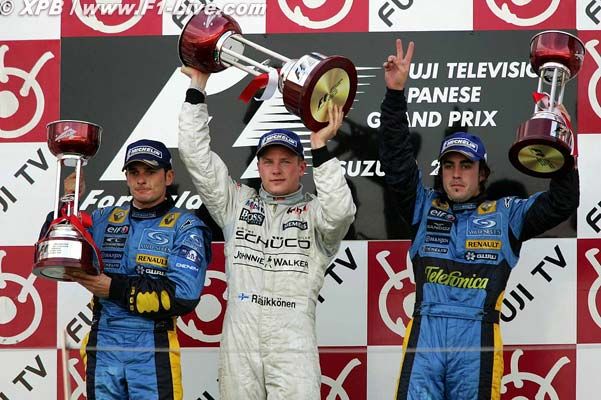
L to R: #2 Giancarlo Fisichella (Renault), #1 Kimi Raikonnen (McLaren), #3 Fernando Alonso (Renault)
"I think it is one of the best for sure," a rather pink-faced Raikkonen said of his victory. "I really had to fight for it and after all the problems we had this weekend, it was very nice. There was a lot happening in the race all the time. When I came up behind Fisichella I was thinking which way I should go. Of course at the inside it is easier to overtake, but Fisichella went to the inside so I didn't have much choice but to go round the outside?"
The result must inevitably cast a shadow on the career of Fisichella for he had what seemed like a huge lead and it had gone away. It was not the sort of display that Renault team boss Flavio Briatore likes to see from one of his cars.
"He was just quicker than me on the straight," Fisichella said. "I did my best."
But his best was not good enough.
Sixteen seconds behind Giancarlo was Alonso and then came Webber who finally had a few things go right for him and rewarded the team with fourth place. He had, however, beaten Jenson Button and David Coulthard both of whom started the day ahead of him. Button said that the cause of his defeat was a dodgy fuel hatch which cost him time in both stops but it is doubtful that it made much difference because Webbber was quicker when it mattered.
Michael Schumacher might have spent the afternoon watching youngsters passing him left and right but he probably deserved better than seventh, having driven the wheels off the beastly Ferrari F2005. Little Bro Ralfie came home eighth. The rest trailed home as normal, the big event being in the mid-race when Albers's Minardi went up in flames for a brief moment after Chrsitijan overshot his mark and the fuel hose had to be stretched a little which resulted in a small spillage and a flash fire. To give Albers some mitigating circumstances, Robert Doornbos also overshot his mark and ran into one of his mechanics.
The Minardi men hobbled home with singed ears.
Renault took14 points from the race and so regained the lead in the Constructors' Championship. The team is now two ahead of McLaren and there is everything to play for in Shanghai this time next week.
If we get a race as good as this one, everyone will be happy.
Subscribe to:
Posts (Atom)